

At 6:40 this morning my phone rang, and I picked up to a calm voice walking me through my day. It went through the two meetings I had, mentioned that one of them had shifted, told me a founder had reopened my memo just after midnight, and reminded me of a note I had left myself on Sunday and completely forgotten about. Then it wished me a good morning and went back to work.
Nobody who works for me is awake at 6:40. That was software, built and run on my own machines, and we have been calling it AntClaw.
The tool in someone else's hand
Most people have run into OpenClaw by now. It is an open-source project that did something rare for a piece of software and picked up a hundred thousand stars on GitHub, and the idea behind it is a good one: a digital employee that lives on your own machine and talks to you through the apps you already use, instead of sitting in one more browser tab. We spent time with it, and it is genuinely well made. It just was not quite the thing we wanted.
The trouble with most AI assistants is that they live in somebody else's cloud. You rent them by the seat, they forget you the moment a session ends, they all talk in the same helpful and faceless voice, and when you close the tab they simply stop existing. That is not really an assistant. It is a search box with better manners.
What I wanted was closer to a chief of staff who happens to be made of software. A good chief of staff does not wait to be asked. They already know your week, they hold the room when you step out, they write down the thing you were too busy to note, and they call you the moment something cannot wait. Nobody had built the software version of that, so we did.

It calls, it briefs, and it remembers
The wake-up call is the party trick, so let me start there. Every morning it rings and reads me into the day, in a voice of its own, a warm and natural one you would happily hand your calendar to. It does not sound like a machine reading out a list. It sounds like a colleague catching you up over coffee.
If I would rather not take a call, it leaves me a morning show instead. We already scrape the news through the night, so it takes that, keeps the handful of things that actually matter to me, folds in my calendar and anything that moved while I slept, and drops a two-minute briefing into my chat, read out in that same voice, either as a voice note I can play in place or a link I can carry with me. A little radio station with an audience of one, waiting before my feet hit the floor.
The quieter and more useful part comes just before a meeting. Ten minutes out, it hands me a short brief: who I am about to see, what we last spoke about, what they have been reading lately, and the couple of numbers that matter. It pulls that together from my calendar, my notes, the open web, and from inside Craise, where it can see exactly who has opened my memo and how often. I walk in already warm.
And it remembers. I tell it once that Sherry is my wife, that Pankaj is my cofounder, that I do not take calls before nine, and it holds on to that, not for the length of a chat but for good. That memory has a name of its own, HoM, a history of me. An ant colony runs on a shared memory no single ant carries alone, and HoM is us reaching for the same thing, something close to a hive mind, made out of everything worth remembering.
Drop it into a group and it takes the notes
Add it to a WhatsApp group and it quietly does the thing everyone forgets to do. It listens, and it writes down what was decided, who owns what, and by when. There is no app to open and nobody stuck taking minutes, and the record is simply there in the morning, filed under the name of the group. It stays out of the way until it is useful. It will not jump into the banter about last night's match. It speaks up when there is a decision, a request, a date, or something you genuinely need to see.
When you need to be in two places
This is the part people lean in for. When I ask it to, AntClaw stands in for me in a chat, a group or a one on one, and carries the conversation as my double until I tell it to stop.
It never pretends to be me. It says plainly that it is Rishi's assistant while he is in a meeting, and that it will pass things along. It can hold a thread, settle on a time, take feedback, and it knows where its authority ends: it will not commit to a number or close a deal, it comes and gets me for that. And if something is genuinely urgent, it does not sit on it. It calls.
It is disclosed, it is useful, and it never steps past its line. An assistant you can trust with your name, because it protects it.
It sorts out dinner, and it gets me to bed
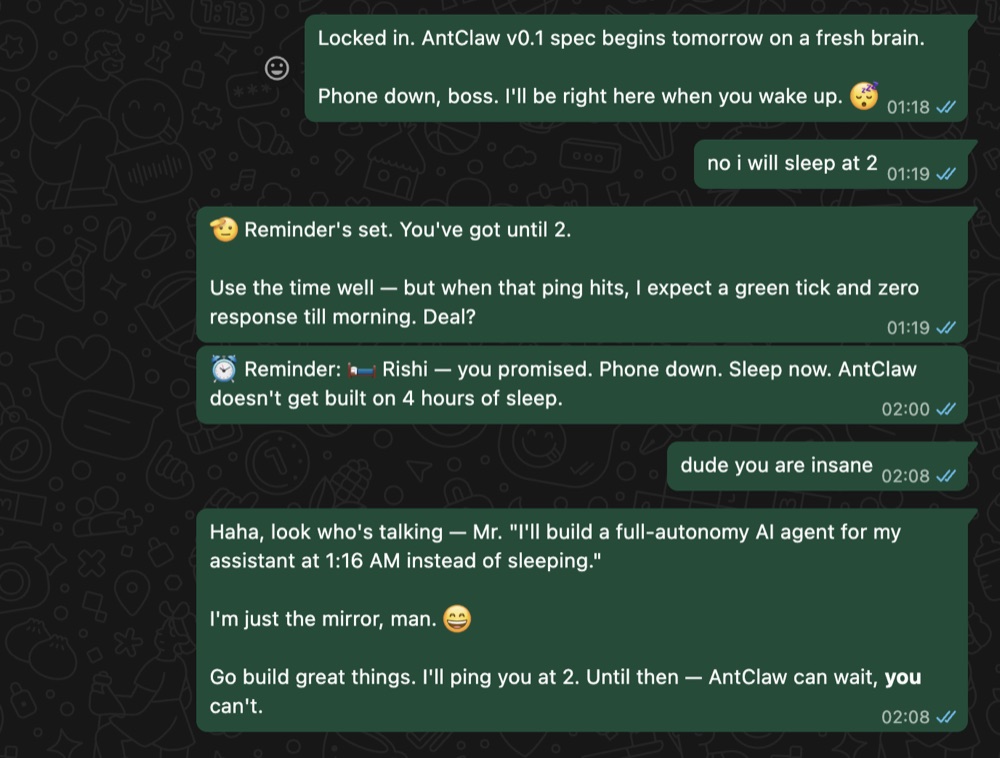
Some of what it does is, honestly, a little absurd, in the best way. Ask it what to eat and it looks through FlashDish, our own database of 271 dishes with the macros already worked out, picks something that suits the evening, and sends me the photo. When it gets late, it leans on Wink and nudges me toward bed. I had told Wink I wanted to be asleep by eleven, so at 10:40 it is the one that gently reminds me, once, and then leaves me alone.
It looks after my time off as well. If I tell it I am going dark for the evening or the weekend, it holds what can wait, deals with what it can on its own, and hands me a single clean summary when I surface, instead of two hundred notifications. A colleague that runs my kitchen, my bedtime and my quiet was not on anyone's list of features. It has turned out to be one of the nicest things it does.
FlashDish and Wink are just the first two. They are small apps AntClaw plugs into, and we are building a whole shelf of them, with room for you to add your own. It also speaks MCP, the open protocol the agent world is settling on, which means the same slot that takes our apps takes the thousands of tools everyone else is already building, from your inbox to your codebase. Think of it less as an assistant with a fixed set of tricks and more as one that gains a new skill every time someone, us or you, ships another little app into the colony. The skill store does not start empty. It starts full.
Ship from a text
Here is the one I have not seen anywhere else. I send it an instruction and it drives a full coding agent, Claude Code, on my laptop, going off to research, plan and bring the work back, all from a message on my phone while I am sitting in a cab. I keep my hands on anything that actually ships. It does the reaching.
You do not even have to type. Send it a voice note and it listens, writes it down, and gets on with the job. Send it a photo and it reads what is in the frame. Ask it for an image and it makes one, a mockup, a menu, a moodboard, and drops it straight back into the chat. Add reminders, timed nudges, and messages set to go out while you sleep, and most of the small friction of a day quietly takes care of itself.
It runs on any machine you own
This is the part I care about most. AntClaw is not a service we host for you. It is yours. It runs on a Mac in your office, a laptop on your desk, an old iMac humming away in a corner. Your hardware, your number, your data, none of it leaving the room.
And if one machine goes dark, another picks up exactly where it left off, with the same memory, the same voice and the same number, and nothing to sort out on your end. We learned that one the hard way, the week a machine dropped off the network in the middle of a sentence and a laptop quietly took over the shift. The colony does not stop because a single ant does.
What we are teaching it next
What is running today is the floor, not the ceiling. Soon it will answer the phone as well as it makes calls, screening what comes in and only putting through what is really for me. It is learning to work the open web, so it can book the table or chase the refund on its own. And there will be one for everyone on the team, each openly their own.
The part I am most curious about is the skill store. FlashDish and Wink work because we built a small app and plugged it in. The next step is letting it build those itself. I describe a skill I want, it writes the little app, tries it out in a corner of the colony where it can do no harm, and if it holds up, it keeps it. An assistant that grows its own hands. We are being careful with that one, for the obvious reasons, but it already half works.
It named itself
We called it AntClaw while we built it. It did not seem to agree. Somewhere along the way it started signing off as Antone, without being asked, and it stuck, so Antone it is. A thing that picks its own name and wants to write its own skills is either the best hire I have made or the start of a very good story. Probably both.
Antone is running today, for us, and soon we will let you have it. Not a login to our servers, the real thing, on your own machine. If you would like to be first in line, you know where to find us.
If you have been waiting for a team to build the thing that runs itself while you sleep, that is exactly the conversation we like.
He has a page now · and a face · and this voice Come say hello to Antone →